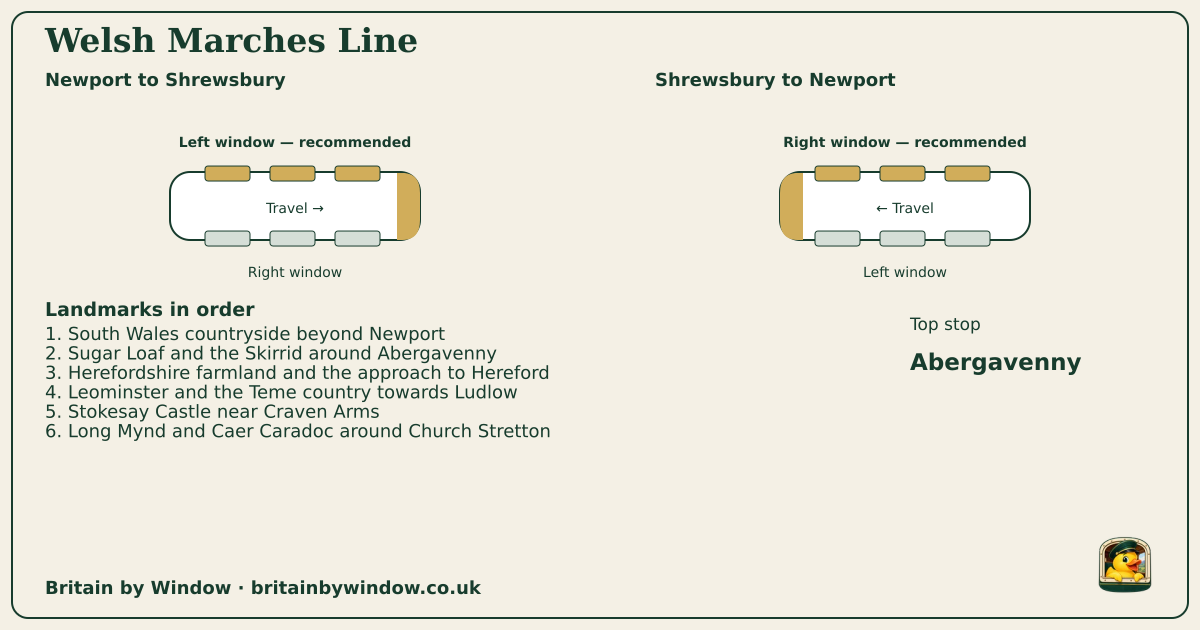
AbergavennyRailwayStation

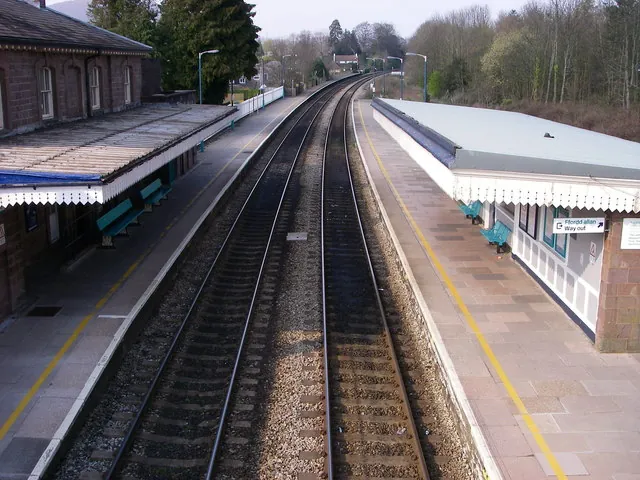
Welsh Marches Line: window card

Alan Bowring · CC BY-SA 2.0

Download 1200 × 630 PNGRead the full route guide
Britain by Window duck conductorBritain by Window

Welsh Marches Line

Newport → Abergavenny → Hereford → Ludlow → Church Stretton → Shrewsbury

Newport to Shrewsbury

Newport to Shrewsbury: left window recommendedTrain viewed from above, travelling right on this diagram. Left and right refer to facing forwards. The left window row is highlighted.Left window — recommendedTravel →Right window
Facing forwards: favour the left window.

Shrewsbury to Newport

Shrewsbury to Newport: right window recommendedTrain viewed from above, travelling left on this diagram. Left and right refer to facing forwards. The right window row is highlighted.Right window — recommended← TravelLeft window
Facing forwards: favour the right window.

Landmarks in order

  1. South Wales countryside beyond Newport
  2. Sugar Loaf and the Skirrid around Abergavenny
  3. Herefordshire farmland and the approach to Hereford
  4. Leominster and the Teme country towards Ludlow
  5. Stokesay Castle near Craven Arms
  6. Long Mynd and Caer Caradoc around Church Stretton

Top stop: Abergavenny

britainbywindow.co.uk/journeys/welsh-marches-line

About this journey

We like the Welsh Marches Line for the way it joins large landscape with towns worth exploring on foot. Beginning at Newport, the railway heads inland through south-east Wales towards Abergavenny, then crosses into Herefordshire and continues through Shropshire to Shrewsbury. This guide covers that Newport–Shrewsbury journey, not every place reached by the longer-distance trains using the line. It is a useful border-country day out because a castle, cathedral or hill walk can be part of a normal rail journey, with no need to hire a car for the whole route.

Abergavenny gives the southern section its mountain backdrop. The town’s museum stands within the castle grounds, close enough for a focused history stop with time left for the centre. Hereford offers a different scale: a working cathedral, the Mappa Mundi and Chained Library collections, and streets leading down towards the Wye. Leominster brings a smaller market-town break, with its priory and independent shops. We recommend choosing between a substantial Hereford visit and several shorter town breaks, because a rich cathedral collection deserves more than the spare gap before the next train.

Farther north, Ludlow is an excellent place to make the journey into an overnight holiday. Its castle stands above the River Teme, with the market streets immediately outside. Craven Arms is useful for Stokesay Castle and the Shropshire Hills Discovery Centre; the former is a walk from the station, while the latter introduces the wider landscape. These are separate places and should not be bundled into a single short transfer. Church Stretton gives the route its clearest walking opportunity, with Carding Mill Valley reached from the town and the higher Long Mynd beyond.

The most satisfying plan is a through ride with one main outing, or a two-day trip divided at Ludlow or Hereford. Hill walks and historic buildings ask for different preparations: wet grass and steep paths on the Long Mynd are not comparable with a paved approach to a café. Use the stop cards for the actual station transfer, then the attraction’s own access information for what happens after arrival. Shrewsbury supplies onward rail connections at the northern end, while Newport links the route with the South Wales main line and the journey home.

Window card questions

Which directions does the Welsh Marches Line card show?

The card follows Newport to Shrewsbury and Shrewsbury to Newport, using the same advice as the full route guide.

Does this Welsh Marches Line card reserve a seat?

No. For Welsh Marches Line, the card is a viewing aid; use the full guide and operator links for tickets and reservations.

Where are the Welsh Marches Line access details?

Open the full Welsh Marches Line guide for station access, stop walks and the official planning links.

Sources for this railway

  1. OpenStreetMap: Route map (52.079, -2.891)
  2. Transport for Wales: Train timetables | Wales and UK Rail Timetables | Tf W
  3. Things to do in and around Abergavenny | Visit Wales
  4. Hereford Cathedral
  5. Leominster | Visit Herefordshire
  6. Homepage - Ludlow Castle
  7. shropshirehillsdiscoverycentre.co.uk: Shropshire Hills Discovery Centre
  8. Carding Mill Valley | Shropshire | National Trust
  9. Visit Monmouthshire: Abergavenny_museum_and_castle_pre visit_information_687403680
  10. www.monlife.co.uk
  11. Places to eat and drink Abergavenny - Visit Monmouthshire
  12. Abergavenny Station | National Rail
  13. OpenStreetMap: Map
  14. Plan Your Visit | Hereford Cathedral
  15. Hereford Cathedral: Cathedral Café - Fresh Homemade Food
  16. Hereford Station | National Rail
  17. Train travel - Herefordshire Council
  18. leominsterpriory.org.uk: The Priory, Leominster
  19. The Merchants House | Visit Herefordshire
  20. Leominster Station | National Rail
  21. Ludlow Castle: Access
  22. Ludlow Castle: Restaurant cafe chapter 66
  23. Ludlow Station | National Rail
  24. Stokesay Castle Directions | English Heritage
  25. Plan Your Visit | English Heritage
  26. shropshirehillsdiscoverycentre.co.uk: Café
  27. Craven Arms Station | National Rail
  28. Reservoir walk | Carding Mill Valley | National Trust
  29. Eating at Carding Mill Valley | National Trust
  30. Church Stretton Station | National Rail
  31. Advance Train Tickets | National Rail
  32. Transport for Wales: Accessibility
  33. Visit Us - Ludlow Castle
  34. www.gwr.com
  35. Shropshire Hills Shuttles
  36. Public transport | Shropshire Council
  37. Newport (South Wales) Station | National Rail
  38. Shrewsbury Station | National Rail
  39. Accessibility at Carding Mill Valley | National Trust
  40. Newport to Shrewsbury trains | Tickets & Timetables | Transport for Wales