Llandudno Junction to Holyhead
Sit on the right (facing forwards) westbound for the sea-facing window once the coast is reached. The North Wales Coast Railway guide recommends that side from Crewe; watch both sides away from the coastal section.1

Wales · North Wales coast, Menai Strait and Anglesey
Llandudno Junction → Holyhead
Castles, coast and the crossing to Anglesey
Mick Knapton at English Wikipedia · CC BY-SA 3.0 · Photograph source
Some links earn us a small commission at no extra cost to you.
Before boarding
A normal scheduled journey along the North Wales Coast Line from the Conwy estuary through Bangor and across the Menai Strait to Anglesey. Sea views, mountain backdrops and the approach to Holy Island make it a useful scenic journey as well as an important intercity railway.
Pick your window
Choose the right westbound or left eastbound for the sea-facing coastal sections.24
Sit on the right (facing forwards) westbound for the sea-facing window once the coast is reached. The North Wales Coast Railway guide recommends that side from Crewe; watch both sides away from the coastal section.1
Sit on the left (facing forwards) towards Llandudno Junction for the sea between Bangor and Conwy. Look across to the other window for inland landmarks.1
Why ride it
Llandudno Junction–Holyhead follows the coast through Conwy, Penmaenmawr and Llanfairfechan before reaching Bangor and crossing the Menai Strait onto Anglesey. It is a sequence of estuary, sea shore, tunnel, bridge and island countryside. Trains may begin farther east, but this guide's scenic section starts at the junction for Llandudno and the Conwy Valley. Check the advertised destination before boarding: the seaside branch to Llandudno is a different route from Holyhead.
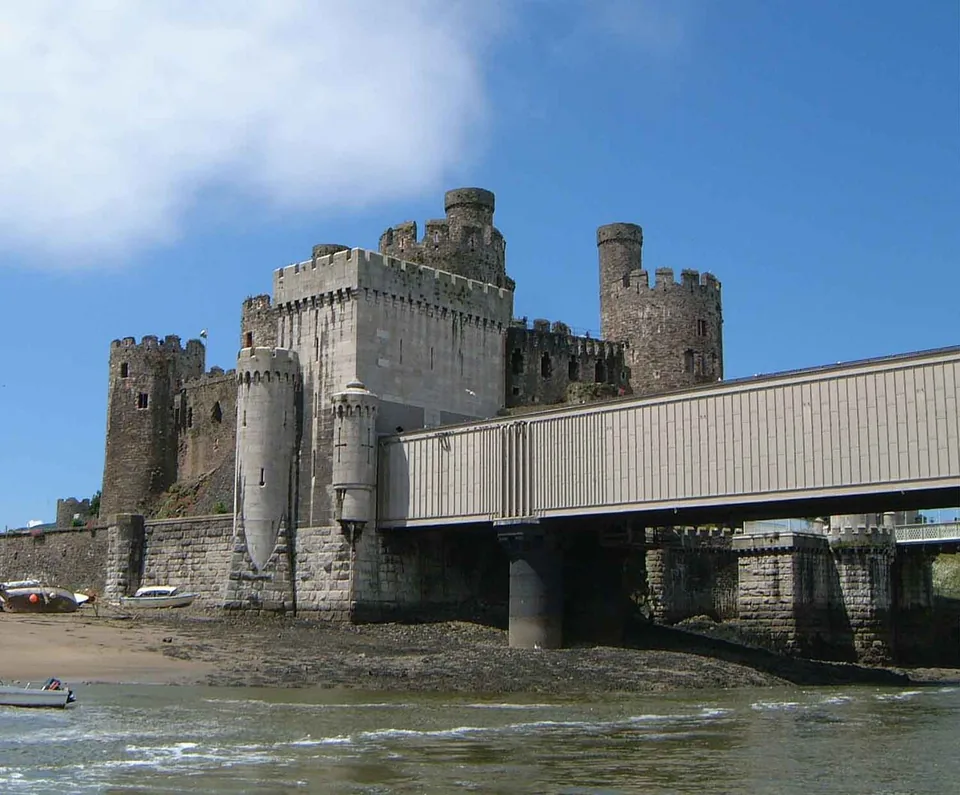
Conwy Castle stands on the inland side of the railway as the train crosses the river into the walled town. The railway bridge beside the castle is Robert Stephenson's tubular structure, distinct from the neighbouring suspension bridge. Beyond Conwy, the railway runs close to the sea beneath the hills at Penmaenmawr and Llanfairfechan. The sea is on the right heading towards Bangor and Holyhead; the left gives the landward mountain and castle setting.
Bangor brings cuttings and tunnels before Britannia Bridge carries trains across the Menai Strait. The older Menai Suspension Bridge is a separate road crossing nearby. On Anglesey, the train leaves the mainland coast for island farmland, then reaches Holyhead on Holy Island. The scenic logic therefore changes after Bangor: a right-hand seat chosen for the mainland sea is not a promise of uninterrupted water all the way to the terminus.
Choose one main stop for a day out. Distances are one way from the station unless a circuit is stated; walking times are our estimates except where the attraction publishes one. Allow-time suggestions include time to look around.
Stop 1
Choose the junction for RSPB Conwy’s lagoons and estuary wildlife.
From the station: 0.5 miles (around 15 minutes’ walk by the direct route)22
How we measureCheck the next train back before leaving the station
Request stop: No — use a service shown as calling here.13
RSPB Conwy Nature Reserve — The reserve has hides, trails and a café beside the Conwy estuary.
Turn left out of the station, then left down Conway Road. Before the Ffordd 6G road bridge, take the right-hand footpath and turn left onto the bridge. Continue south on the pavement past Tesco and the cinema, crossing at the A55 roundabout for the reserve entrance. This is the RSPB’s direct half-mile route; the longer estuary route is different.
Access: The station is category A with step-free platform access. The direct approach uses pavements and busy-road crossings, while the longer estuary option described by the RSPB includes steps. Reserve trails have their own access information; the Blue Tit trail is described as accessible, but that is not a statement about every route from the station.
Waterside Coffee Shop, RSPB Conwy — The reserve café provides a named refreshment stop after the station approach.
Allow time: Allow 2–3 hours for the reserve and café, including the walks back to the junction.
Some links earn us a small commission at no extra cost to you.
Stop 2
Get off inside the walls for the castle, harbour and medieval streets.
From the station: 600 metres / about 0.37 miles (around 10–15 minutes’ walk)6
How we measureCadw publishes 0.6km/0.4mi from Conwy station; we retain the metric distance. TfW describes a shorter four-minute walk, so we allow longer for the signed town approach.
Check the next train back before leaving the station
Request stop: No — use a service shown as calling here.13
Conwy Castle — Cadw’s castle rises above the estuary, with ground-level views as well as steep tower staircases.
Leave the station for the streets within the town walls and follow the signed castle route towards Rose Hill Street and the visitor entrance. Cadw publishes 600 metres from Conwy station. The approach rises towards the castle; the castle towers and wall walks add steep climbs beyond the street walk.
Access: Conwy station is category B2 with some step-free platform access. Cadw says the castle can be enjoyed at ground level, but its wall walks and many rooms require steep, narrow and sometimes uneven stairs. We recommend treating the towers as an optional climb, not part of a step-free visit.
The Castle Hotel — The High Street hotel has a bar and restaurant within the walled town.
Allow time: Allow 2–3 hours for the castle, streets and harbour, with longer for a meal.
Some links earn us a small commission at no extra cost to you.
Stop 3
Pause for the cathedral and Storiel’s cultural quarter in the city centre.
From the station: about 0.74 miles (around 20 minutes’ walk)2620
How we measureMeasured from Bangor railway station to the mapped cathedral site. Walking time is estimated; the return includes a climb.
Check the next train back before leaving the station
Request stop: No — use a service shown as calling here.13
Bangor Cathedral — The cathedral has Gothic columns and stained glass on a site used for Christian worship since the sixth century.
Leave the station towards the city centre and follow the public street route to the cathedral by High Street. The measured distance is shown above; the approach descends into the centre, with a climb on the return. Storiel’s museum and café are in the same central area, so this is a compact city stop instead of the much longer excursion to Penrhyn Castle.
Access: Bangor station is category A with step-free platform access and lifts. The cathedral’s heritage access listing records level access to its main areas, but arrange the appropriate entrance with the cathedral; town gradients and doorways are separate from station accessibility.
Siabod @ Storiel — The museum café serves homemade food in Bangor’s central cultural venue.
Allow time: Allow 1½–2 hours for the cathedral, Storiel and refreshments before continuing towards Anglesey.
Some links earn us a small commission at no extra cost to you.
Stop 4
Finish with the harbour, St Cybi’s Church and the town’s maritime history.
From the station: about 3-mile station circuit (around 1½–2 hours’ walking)24
How we measureCheck the next train back before leaving the station
Request stop: No — use a service shown as calling here.18
Holyhead circular town walk — The council’s full loop connects the station with Market Street, the marina and the Maritime Museum.
The published circuit can start at the railway station. Turn towards the port roundabout, cross the port entrance and follow Turkey Shore Road before the signed climb to Skinner’s Monument. Return towards the station, cross the road bridge into town and follow Market Street and Newry Street to the marina. Complete the loop past the Maritime Museum and across Celtic Gateway Bridge. The full loop is about 3 miles and includes hills and steps.
Access: The council’s full circuit includes steps at the monument and on the return towards Celtic Gateway Bridge, with hills between the town and waterfront. For a shorter visit without those climbs, stay on the town streets and check the station’s access information before choosing an exit.
The Harbourfront Bistro — The restaurant and bar stands next to the Maritime Museum on Newry Beach.
Allow time: Allow 3–4 hours for the circuit, the harbour and a meal; allow extra for a museum visit.
Some links earn us a small commission at no extra cost to you.
Community photographs
A selected visual sequence of railway, landscape and stations along the journey.


Eight route photographs link to their original Wikimedia Commons pages for the creator, licence and reuse terms.
Join this section at Llandudno Junction, the main-line interchange for Llandudno and the Conwy Valley. Arrive along the North Wales coast route from Chester and continue west through Conwy and Bangor to Holyhead.319
RSPB Conwy’s travel page gives bus access via the Llandudno Junction area and the reserve approach. For Holyhead, the railway station adjoins the ferry terminal, so follow the ferry operator’s passenger instructions when combining sea and rail travel.2218
Use the station parking information for Llandudno Junction, Bangor or Holyhead if leaving a car for a return rail trip. Conwy Castle’s visitor information gives separate town parking arrangements; its town station is not the same as Llandudno Junction.1916186
Return from Holyhead eastwards along the same coast line to Bangor and Llandudno Junction. Conwy and Llanfairpwll are now permanent timetable calls, following the operator’s change from request-stop status; still check that the particular train serves the station you need.1318
Make Holyhead the focus of a day trip, or stop in Bangor for the waterfront and Menai Strait before continuing. An overnight on Anglesey gives more room for coastal walks or onward local transport. Confirm whether your chosen train runs through or requires a change, and always check the current Transport for Wales journey planner.1
Llandudno Junction has step-free access to all platforms via lifts, but facilities vary along the route. Use Transport for Wales station accessibility pages for each planned stop and request Passenger Assist where helpful. Ferry, bus and walking connections beyond Holyhead station should be assessed separately.5
Spring and summer offer the longest daylight and clearest opportunity to combine the railway with Anglesey’s coast. Autumn can give dramatic skies; winter journeys remain possible but weather, engineering work and limited daylight can reduce the value of a long stop-off plan.1
Transport for Wales sells ordinary rail tickets for the coastal journey. Some services continue from places farther east; confirm whether the chosen departure runs through to Holyhead. For a trip with several stops or buses, the North Wales Rover has zone-based versions and an all-zone option. Read its rail and bus coverage before buying: choosing too few zones can exclude part of the itinerary. Heritage railways and ferries are separate bookings. Ticket validity for stop-offs must be checked against the selected fare, including any restriction to a particular train.9
Use the right-hand window westbound for the sea between Conwy and Bangor. On the opposite side, Conwy Castle is a short-lived subject as the railway crosses the river and passes the walls. Britannia Bridge gives a moving view of the Menai Strait, not a platform where passengers can stop. A visit to Conwy or an independently planned waterfront walk provides time for photographs from land. Reflections become more visible when the carriage interior is brighter than the sea outside.1
The route is a working railway serving coastal communities and the Holyhead interchange. Train length, seat alignment and catering vary by service; a window reservation does not fix which side of the carriage faces the sea. Llandudno Junction offers a connection to the Conwy Valley, while Bangor supplies station facilities for a pause before Anglesey. Keep ferry luggage clear of doorways and allow the advertised transfer time at Holyhead. A railway ticket and a sailing reservation cover different parts of the journey.1
Allow roughly one to one-and-a-half hours between Llandudno Junction and Holyhead, depending on stops. Check the current TfW timetable; a day with Conwy or Bangor visits needs additional waiting and walking time.1
Sit on the right (facing forwards) westbound for the sea-facing window once the coast is reached. The North Wales Coast Railway guide recommends that side from Crewe; watch both sides away from the coastal section.1
Yes. A through ride can include one town stop, such as Conwy or Bangor. An extended coastal walk on Anglesey or a ferry trip needs a separate connection plan and more time.684
TfW publishes station access details and provides Passenger Assist. Bangor has lifts between platforms, but confirm facilities at every intended stop. Castle stairs, coastal paths and ferry boarding have separate requirements.84
Join this section at Llandudno Junction, the main-line interchange for Llandudno and the Conwy Valley. Arrive along the North Wales coast route from Chester and continue west through Conwy and Bangor to Holyhead.319
Read the route
Chosen for this line, its train type or the wider pleasure of slow rail travel.
by Tom Chesshyre
A contemporary, slow-travel circuit of Britain for readers who enjoy the journey as much as the destination.
View physical book (opens in a new tab)by Sherin Aminossehe
An illustrated history told through fourteen journeys—a useful companion for the wider collection.
View physical book (opens in a new tab)Further reading
Official planning
Book with the railway, or use National Rail to put your journey together.
Some links earn us a small commission at no extra cost to you.
Find places to stay in Holyhead on Booking.com (opens in a new tab) Open North Wales Coast Railway: Crewe to Holyhead (opens in a new tab) Book your tickets (opens in a new tab)Continue exploring